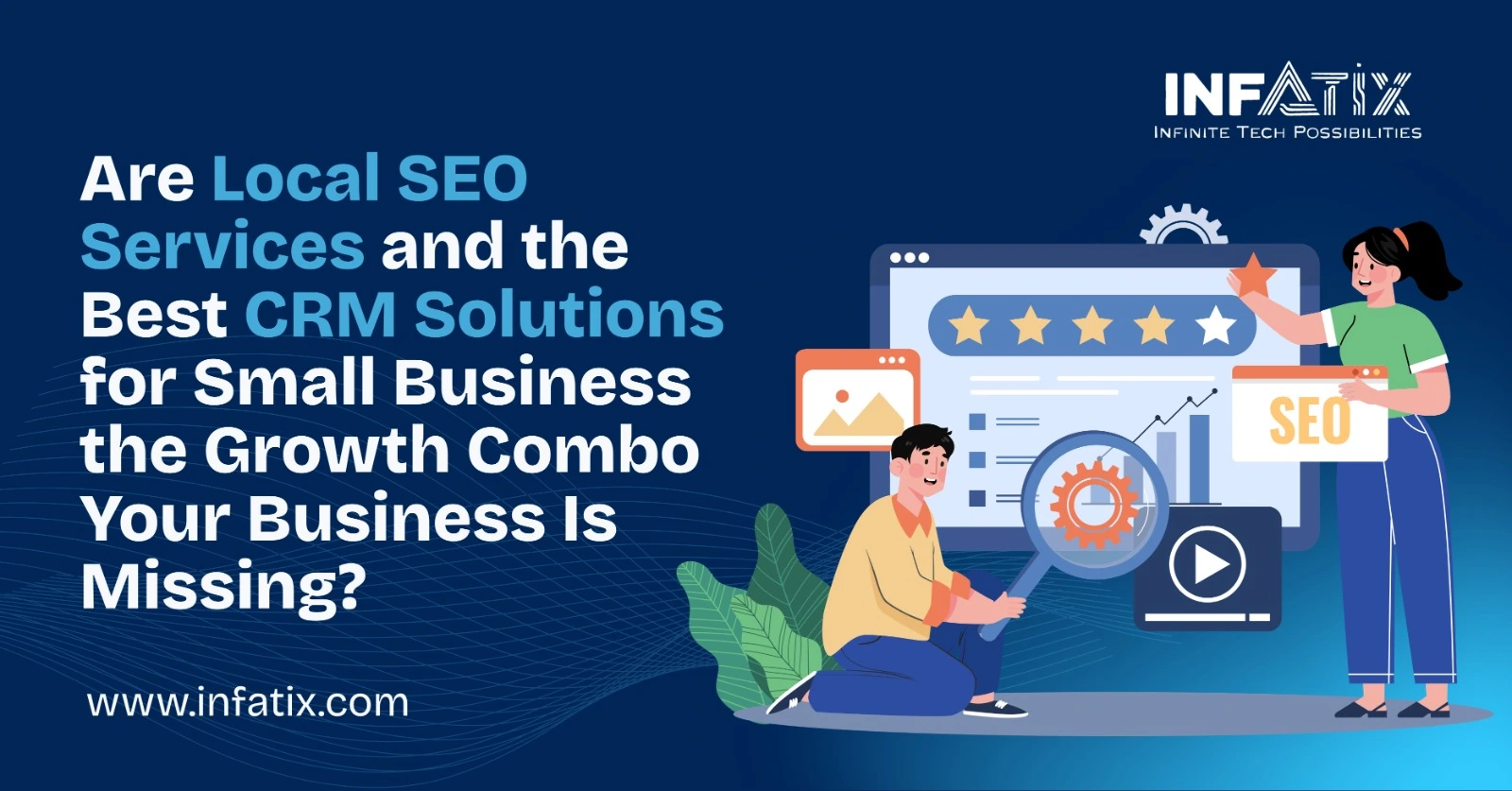
Most small businesses treat digital marketing and customer management as two completely separate problems. Marketing gets a budget. CRM gets a spreadsheet. The two rarely talk to each other, and the business ends up with leads it cannot track and customers it cannot retain.
That gap is expensive. A business can run solid Local SEO Services for Businesses and generate consistent enquiries — but if those enquiries fall into a disorganised inbox with no follow-up system, the SEO spend is largely wasted. Conversely, a business with a well-structured CRM but no local visibility is managing a pipeline that never fills up properly.
The businesses growing fastest in 2026 are the ones that have stopped treating these as separate conversations. Local SEO brings in the right people. A CRM keeps them. Together, they work in a way that neither does alone.
This blog is for small business owners who want to understand both — what each one actually involves, where most businesses go wrong, and how to use them together without needing a large team or a large budget.
What Local SEO Actually Means for a Small Business
Local SEO is not just about showing up on Google. It is about showing up when someone nearby is actively looking for what you sell. That distinction matters. A person searching "web development company near me" or "best CRM consultant in Noida" is not browsing — they are close to making a decision.
Google's local results are driven by three things: relevance, distance, and prominence. Relevance is how well your business matches the search. Distance is how close you are to the searcher. Prominence is how credible and well-represented your business appears online — reviews, citations, backlinks, and activity on your Google Business Profile all feed into this.
Most small businesses underinvest in prominence. They set up a Google Business Profile once, never update it, collect a handful of reviews in the first month, and then wonder why a competitor with a newer listing is outranking them.
The fix is straightforward, even if it requires consistency. A regularly updated GBP, a clean and consistent NAP (name, address, phone number) across every directory and platform, localised content on the website, and a steady stream of recent reviews — these are the inputs that produce local rankings. None of them are technically complicated, but all of them require ongoing attention.
There is also a real opportunity for businesses in mid-sized Indian cities. Local SEO competition in Noida, Ghaziabad, Meerut, Agra, or Lucknow is considerably thinner than in Mumbai or Delhi. A business in these markets that invests in local SEO now is building visibility its competitors will struggle to match later.
Why a CRM Is the Other Half of the Equation
Getting found online is step one. What happens after someone contacts you is where most small businesses quietly lose business they should have won.
The pattern is familiar. A lead comes in through the website or a WhatsApp message. Someone responds. There is a back-and-forth. Then life gets busy, a follow-up gets missed, and three weeks later that lead has gone with a competitor who called back twice.
This is not a sales problem. It is a process problem — and it is exactly what a CRM is built to solve.
At its core, a CRM is a shared, organised record of every customer and prospect interaction. Who reached out, when, what was discussed, and what needs to happen next. That last part is the one most businesses skip: the next step, assigned to someone, with a date on it.
What Small Businesses Should Look For in a CRM
The best CRM for a small business is not the most feature-rich one. It is the one the team will actually use.
For most small teams, the must-haves are: a clear pipeline view showing where each deal stands, automated reminders for follow-ups, email integration so conversations are logged without manual effort, and a mobile app for people who are not at a desk all day.
The features to be cautious about are the ones built for enterprise scale — AI-driven forecasting, territory management, multi-level approval workflows. These add complexity without adding value for a ten-person business. The simpler the system, the higher the adoption.
Off-the-shelf CRMs — Zoho, HubSpot, Freshsales — work well when the sales process is fairly standard. If you are running a services business with a predictable pipeline, one of these will likely serve you well at a reasonable monthly cost.
Custom CRM development is worth considering when the process is genuinely unusual. A real estate developer managing site visits, booking stages, payment milestones, and post-handover queries has needs no generic platform covers cleanly. The same applies to manufacturing companies tracking custom orders through multiple production stages, or healthcare providers juggling appointments, records, and billing. In these cases, a CRM shaped around the business — rather than the other way around — produces better outcomes and better team adoption.
How the Two Work Together
Here is what the combination looks like in practice.
A local SEO strategy gets a business appearing in search results when nearby customers are actively looking. Those customers click through, fill out a form, send a WhatsApp, or call. That enquiry lands in the CRM, where it is assigned, tracked, and followed up systematically. The team knows exactly what stage every prospect is at. Nothing falls through. Conversion rates go up not because the pitch improved but because the process stopped leaking.
Over time, the CRM also feeds back into the local SEO strategy. Customer data reveals which services generate the most leads, which locations produce the most enquiries, and which keywords are actually converting — not just generating traffic. That information sharpens the SEO targeting.
Neither tool produces results in isolation. Together, they create a loop: visibility brings in leads, the CRM converts and retains them, and the data from retention informs better visibility.
How Infatix Approaches Both
Infatix — which evolved from Skylite Software — is a full-service digital agency working with clients across India and globally. The team handles website development, mobile app development, ERP and CRM development, digital marketing, SEO, and PR services. That range matters here because local SEO and CRM do not live in separate departments at Infatix — they are part of the same conversation about how a business grows.
When a client comes in asking about local visibility, the team looks at the full picture: where enquiries are currently coming from, how they are being handled, and where the biggest leaks are. Sometimes the priority is clearly SEO. Sometimes it is clearly CRM. Often it is both, sequenced in a way that makes sense for the business's current stage and budget.
For businesses that want to stop treating digital marketing and customer management as separate problems, Best CRM Solutions for Small Business combined with a structured local SEO plan is where the real returns start to show.
The businesses that see the strongest results are those that commit to both — not necessarily at once, but with a clear plan for how the two connect. Start with whichever gap is costing you more today, build the other alongside it, and track the results closely enough to know what is working.